
About Bratislava, Slovakia:
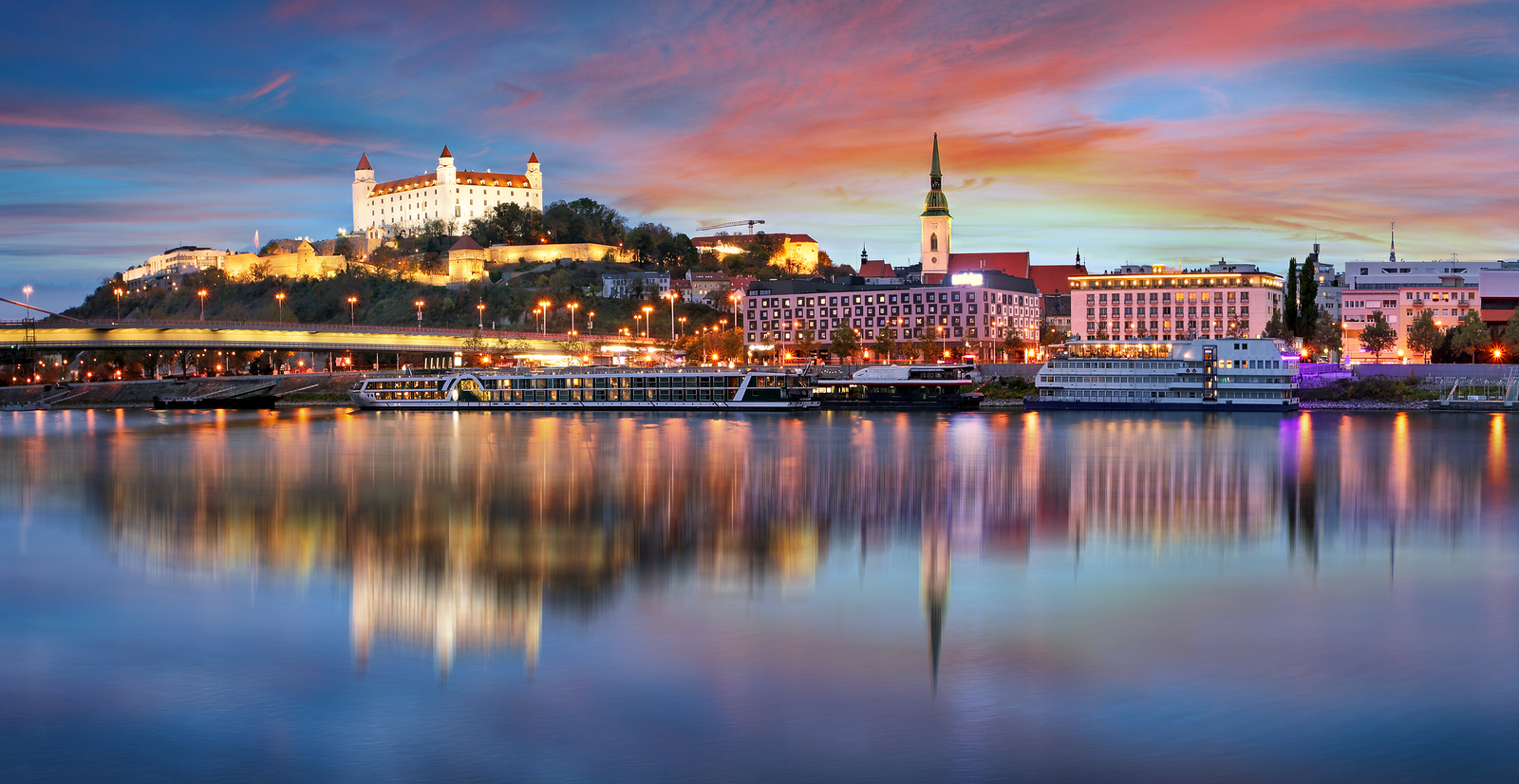
The capital city of Slovakia, Bratislava is its major city center. Located on the Danube River, the center of the city is pedestrian-only. It is a great city to visit…not over-run with tourists but plenty to see and do. Prior to the Communist years it also had a great Catholic history that is now being restored. Bratislava’s Catholic history stretches from early Christian roots in the Great Moravian period (c. 833–907 AD) through its role as a major Hungarian royal and ecclesiastical center in the late 13th and early 14th centuries, with its role peaking in the 16th century under Habsburg rule.
Christianity reached the region in the early Middle Ages. Archaeological evidence includes early Christian structures at Devín and Bratislava Castle (including Great Moravian foundations). In 863, Saints Cyril and Methodius arrived in Great Moravia at the request of Prince Rastislav; they promoted a Slavic liturgy, translated texts into Old Church Slavonic, and helped establish deeper Christian practice among the Slavs of the area that includes present-day Slovakia.
In the High Middle Ages, as the settlement (known historically as Pressburg/Pozsony) developed under the Kingdom of Hungary, key Catholic institutions appeared. A chapter and church dedicated to the Holy Saviour existed at the castle; the parish church was later relocated below the castle (papal permission in 1204, move completed around 1221).
The Franciscan Church (Church of the Annunciation), the oldest surviving sacral building in the Old Town, was consecrated in 1297 in the presence of King Andrew III. Construction of the present Gothic St. Martin’s Cathedral began in the early 14th century on the site of earlier churches and a cemetery; it was consecrated in 1452 (dedicated initially to the Holy Saviour and St. Martin). St. Martin’s Cathedral served as the coronation church from 1563 to 1830; 19 coronations of Habsburg monarchs and consorts took place there (including Maria Theresa in 1741).
The Franciscan Church was used for related ceremonies, such as the election of Ferdinand I in 1526 and the knighting of Knights of the Golden Spur (in the Holy Roman Empire, equites aurati Sancti Romani Imperii (“Golden Knights of the Holy Roman Empire”) were members of the gentry, bourgeoisie, or aristocracy honored for special services).
The Reformation strongly affected the city in the 16th–17th centuries (Protestants temporarily controlled St. Martin’s around 1619–1621), but the Counter-Reformation and Habsburg rule restored Catholic dominance. Baroque churches followed, including the Trinitarian Church (Holy Trinity, consecrated 1725, built by the Order of the Most Holy Trinity) and Capuchin foundations.
In the modern era, the city remained under the Archdiocese of Esztergom for centuries.
Among the main places of interest for Catholics in Bratislava are:
After the creation of Czechoslovakia, an Apostolic Administration of Trnava was erected in 1922; it became the Archdiocese of Trnava in 1977 and was renamed Bratislava-Trnava in 1995 (with St. Martin’s as co-cathedral). On February 14, 2008, Pope Benedict XVI established the separate Archdiocese of Bratislava as the metropolitan see of the Western Province of Slovakia, with St. Martin’s Cathedral as its cathedral and St. Martin of Tours as patron. The archdiocese continues as the primary Catholic jurisdiction for the capital and surrounding areas.
Notable sites today include St. Martin’s Cathedral (Gothic coronation church with later Baroque elements), the Franciscan Church and monastery, the Trinitarian Church, and pilgrimage-related locations such as the nearby Marian shrine at Marianka.
Grave of Blessed Cecília Schelingová in Podunajské Biskupice.
The Blue Church (Church of Saint Elisabeth)
Traveling to Bratislava, Slovakia:
By plane:Bratislava’s M. R. Štefánik Airport is the main international airport in Slovakia. There is international service at this airport, and many also arrive through the Vienna airport, which is only about 30 miles away.
By train:There are also excellent rail connections to the city (note there are two train stations). Two Key Train Stations in Bratislava
1. Bratislava hlavná stanica (Main Station): The largest and most important railway station in Bratislava, serving most international, long‑distance, and regional trains Bratis.
International routes to Austria, Czech Republic, Germany, Hungary, Poland, Serbia, Switzerland, and others; domestic routes to other Slovak cities WikipediaWikipedia.
Location: Námestie Franza Liszta 1, city center.
2. Bratislava–Petržalka station: Smaller than the main station, with public transport links (bus no. 93 to Main Station). If you need to reach Vienna or other Austrian cities, Petržalka is often the most direct option. .
Location: Petržalka district, about 15 minutes by bus from the main station.
And some Danube River cruises include Bratislava in the itineraries.